










Non gamstop bank transfer casinos lack access to UK Faster Payments rails
Offshore gambling operators cannot connect to the domestic Faster Payment System because Pay.UK restricts participation to authorised financial institutions and regulated merchants. While domestic transfers clear in real time 365 days per year, a bank transfer casino non uk relies on international SWIFT or SEPA routing that adds cost and clearing friction.
| Banking Parameter | UKGC Licensed Casinos (Pay.UK) | Non-GAMSTOP Offshore Sites (SWIFT/SEPA, non-GBP) |
|---|---|---|
| Clearing Network | Faster Payment System (real-time, 365 days per year) | Cross-border SWIFT and SEPA wire networks |
| Currency & FX Fees | Direct sterling (GBP) settlement without conversion | Foreign currency billing with bank conversion charges |
| Withdrawal Timeframe | Real-time domestic clearing after operator approval | Multi-day international correspondent bank routing |
| Dispute Protection (ADR) | Free independent ADR referral after 8 weeks | No UKGC protection or regulated ADR recourse |
Pay.UK has operated the domestic real-time network since 2008 and supports individual payments of up to 1 million pounds, though member banks set their own transaction limits. Comparing these instant domestic rails with offshore wire networks highlights why choosing the safest bank transfer casinos protects both your balance and withdrawal speed.
Manual IBAN and BIC forms replace one-tap UK sort code transfers offshore
Sending money to an overseas cashier requires typing an International Bank Account Number and Bank Identifier Code instead of approving an Open Banking prompt. Because GAMSTOP participation became a mandatory Gambling Commission licence condition on 31 March 2020, any non gamstop casino bank transfer bypasses domestic Pay by Bank APIs entirely.
Manual entry increases the risk of mistyped routing characters, which can freeze funds in intermediary clearing queues and trigger administrative recall fees from your bank.
Non gamstop bank transfer casinos often bill in euros, not sterling
Offshore cashier desks settle wire transactions in foreign currencies rather than sterling, forcing British current accounts to absorb double currency conversion spreads. Every deposit and withdrawal loses value against the mid-market exchange rate before reaching the recipient balance. When currency losses on euro-billed transfers start to add up, you can call the National Gambling Helpline (run by GamCare) on 0808 8020 133, free, 24 hours a day, 7 days a week.
- Percentage foreign exchange markups applied by UK retail banks on outbound international wires.
- Fixed international SWIFT dispatch fees deducted before the deposit leaves Great Britain.
- Secondary conversion losses when foreign currency payouts arrive back into a sterling current account.
- Receiving bank handling charges applied to incoming cross-border wire settlements.
Under Gambling Commission rules, customer gambling winnings in Great Britain are 0 tax-free regardless of the amount won, as tax is levied on operators' Gross Gambling Yield, and HMRC confirms that betting and gambling do not constitute trading. However, using an offshore bank account for gambling erodes those tax-free returns through avoidable banking overheads:
Intermediary correspondent banks deduct handling charges from cross-border wires
When an overseas operator lacks a direct clearing relationship with your British bank, the wire travels through one or more intermediary correspondent banks. Each routing institution along the SWIFT chain deducts a handling fee directly from the principal transfer amount.
Players checking a foreign cashier or searching for utländska casino bank transfer options often find that the net payout landing in their UK account is noticeably smaller than the withdrawal requested.
Cross-border wire payouts from non-UK casinos take up to seven working days
International wire withdrawals require manual compliance checks and sequential batch clearing across multiple time zones, delaying settlement for several working days. Unlike domestic Faster Payments that settle almost immediately, cross-border transfers pause during weekends and foreign public holidays.
The Gambling Commission notes that unlicensed operators frequently lack regulated payment systems and may set withdrawal limits so high they become unattainable for regular customers. Understanding how long does it take money to transfer to another bank internationally clarifies why domestic fast bank transfer casino platforms save days of waiting.
UK high-street banks decline outbound wire transfers to unlicensed merchants
British retail banks actively monitor merchant category codes and IBAN destinations, automatically declining outbound wires aimed at unregulated offshore gambling accounts. Compliance departments flag cross-border transfers to known unlicensed payment processors to prevent financial crime and protect account holders.
Furthermore, the Gambling Commission credit card prohibition means gambling businesses must not accept credit card payments, so players cannot fund bank transfers or casino balances using credit facilities. When customers ask why won't my bank allow gambling transactions to overseas IBANs, the refusal stems from regulatory compliance filters and unlicensed merchant risk.
Foreign permits do not legalise offshore bank transfer casinos in Great Britain
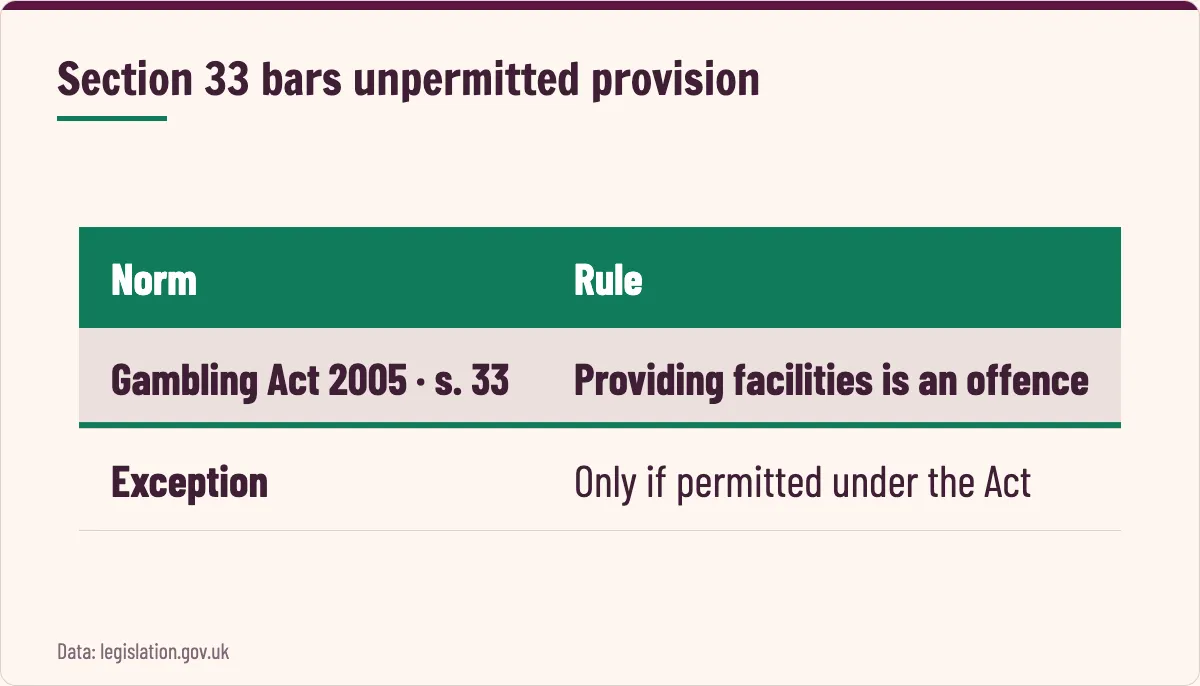
An offshore gambling permit issued outside the United Kingdom does not authorise an operator to accept bank transfers from residents in Great Britain. Under section 33 of the Gambling Act 2005, providing facilities for gambling to British consumers without a Gambling Commission operating licence is a criminal offence, regardless of where in the world the operator is based.
The Gambling Commission advises players to verify that a business holds an active licence before depositing, noting that licensed operators must clearly display their regulatory status on their website. If you encounter an unlicensed platform targeting British bank accounts, the regulator provides an online service to confidentially report illegal gambling activities, though this reporting form does not handle individual financial complaints.
Unlicensed offshore sites risk blocked bank payouts and exposed financial data
Uploading bank statements, sort codes, and identity documents to non-GAMSTOP offshore operators exposes British players to identity theft and financial fraud. The Gambling Commission states that illegal non-GAMSTOP gambling sites frequently block wire payouts or set withdrawal thresholds so high that cashing out becomes unattainable.
Because operators outside GAMSTOP bypass British consumer and gambling protection rules, sensitive banking records sent for manual wire verification carry serious data protection risks.
Wiring money to an offshore casino removes free UK ADR dispute protection
Sending a wire transfer to an unlicensed non gamstop bank transfer casinos operator leaves you with zero access to British Alternative Dispute Resolution (ADR) if your withdrawal goes missing. At regulated sites, players first complain directly to the operator and, after eight weeks, can escalate unresolved payment disputes to a free, independent ADR provider.
While regulated ADR schemes do not accept complaints regarding general customer service issues, they adjudicate withheld funds and contract disputes for licensed operators. Unlicensed offshore sites lack any recognised dispute resolution scheme, which is why consulting a verified list of bank transfer casinos regulated in Great Britain is essential before moving funds.
GAMSTOP exclusions run up to five years and require manual deactivation
GAMSTOP blocks access to online gambling companies licensed in Great Britain for a minimum period of six months, one year, or five years. Operated by The National Online Self Exclusion Scheme Limited in England and Wales, the scheme also offers a five-year auto-renewal option where a new five-year period automatically begins when the current one ends.
Deactivating a finished exclusion requires a 24-hour cooling-off period
GAMSTOP never lifts a restriction automatically when the chosen minimum exclusion period ends. Instead, the individual must contact the GAMSTOP Contact Centre to request deactivation and complete a minimum 24-hour cooling-off period.